

Quick installation
Install with Cursor
One-click installation directly in Cursor
Endpoint
Hosted Streamable HTTP endpoint (served on Browserbase infrastructure):Prerequisites
1
Get your Browserbase credentials
Get your Browserbase API key from the Browserbase Dashboard.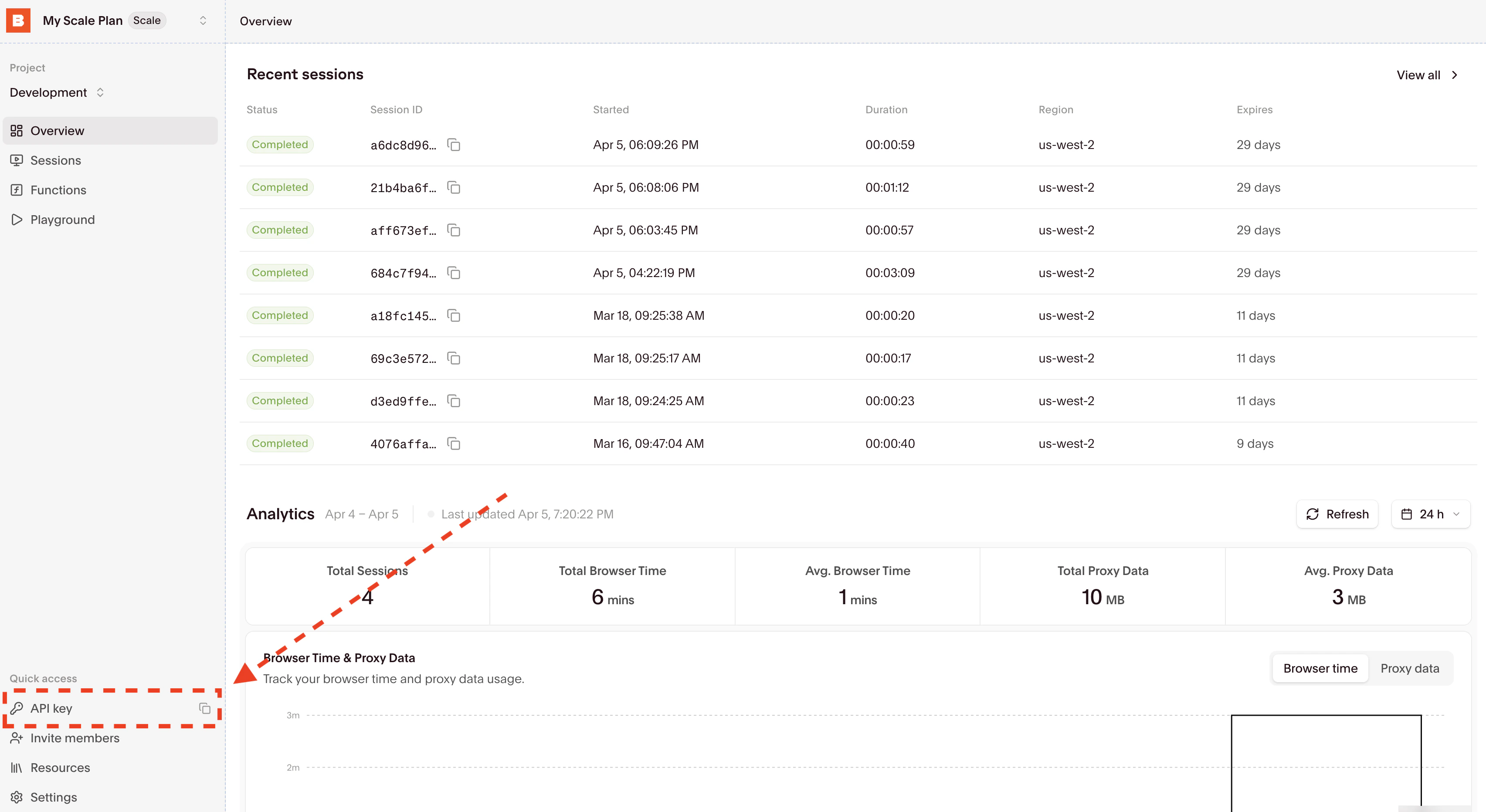
Query parameters (hosted Streamable HTTP)
Required for tool calls
browserbaseApiKey
Browserbase API key.
Optional
Available tools
Every tool below accepts an optionalsessionId parameter. Pass the sessionId returned by start to target or reattach to that specific Browserbase session; if omitted, the tool uses the transport’s current active session. This matters for MCP clients (e.g. ChatGPT) that don’t carry the same Mcp-Session-Id across requests: pass sessionId explicitly on every call to reliably target the right browser session. See Session reattachment below.
act
act
observe
observe
extract
extract
start
start
end
end
Close a Browserbase session.
string
Optional Browserbase session ID to close. Defaults to the current active session. Closing a session by explicit ID only clears the transport’s active-session state when that ID is the current session.
Session reattachment
The hosted endpoint (mcp.browserbase.com) keeps track of an active Browserbase session per MCP transport (Mcp-Session-Id). Some MCP clients open a new transport on every tool call instead of reusing one, which means the server has no active session to fall back to and calls fail with No active session.
To work reliably with these clients, pass the sessionId returned by start on every subsequent tool call. An explicit sessionId always takes priority over the transport’s current session. The hosted endpoint adopts a session as the transport’s active session only after confirming that session still exists, so a stale or incorrect sessionId surfaces an error instead of silently redirecting a later call.
Local command-line flags
Command-line flags are only available when running the server locally (
npx @browserbasehq/mcp with flags or local development setup).Installation methods
- Hosted (recommended)
- NPM Package (STDIO)
- Local Development
Use your MCP client config:For custom models, include
modelName and modelApiKey:Verify installation
1
Restart your MCP client
Restart/refresh your MCP client app and verify tools are available.
2
Test the integration
Get started by asking your MCP client to navigate to any page and see your Browserbase browser in action on the dashboard.
Further reading
Model Context Protocol (MCP) docs
Learn more about the MCP protocol
Browse CLI
Control a browser session from your terminal.